Got a minute to help? take our quick website survey >
What is advocacy for mental health?
We might not always feel like professionals listen to our thoughts and opinions, especially when getting treatment and support for our mental health.
Sometimes we need to talk to lots of professionals, like doctors, social workers and therapists. This can feel overwhelming and upsetting. Especially if they don't always ask what we think or involve us in decisions – this is where advocacy can help.
Advocacy means getting support from someone to help us express our views and stand up for our rights.
What's on this page?
Jump to information on:
- What is an advocate?
- How can an advocate help me?
- What types of advocacy are there?
- When do I have a legal right to advocacy?
- What if I don't have a legal right to advocacy?
- How can I find an advocate?
- What if I'm not happy with my advocate?
- Can family, friends or partners advocate for me?
- How can I advocate for myself?
I don't think a lot of young people know about advocacy and it's important to be informed about it.
What is an advocate?
Professional advocates help us speak up about things that are important to us. Different types of advocates can help us in different ways.
They are independent, which means they don't work for the NHS, local councils or social services.
Young people we spoke to described an advocate as someone who:
Can speak up for you and voice your point of view when you feel like you can't do it yourself.
Can represent you and make sure your views are understood.
Can guide you through a situation by helping you to decide what to do.
Knows the system better than you and knows what's going on. They're up on medical language and know how to explain in a way that you can understand.
Supports you in situations and can speak on your behalf if you want that. It could be emotional support so they can help you articulate how you're feeling.
We asked advocates to explain how they might help young people:
We can help you make informed decisions and work through all the options, but the decision is up to you.
We will genuinely be there 100% for the person. To give them that voice, to stand up for their rights and to move forward in the way they want.
I see my role as ensuring people's rights. Not only helping them understand their rights, but also how to exercise them. I echo or strengthen their voice and raise issues with or on behalf of them. While also building confidence and strategies that they can then use to self-advocate in the future.
How can an advocate help me?
Advocates can provide different types of support depending on your situation and what you need help with.
In situations that involve your mental health treatment and support, advocates can:
- Listen to you. For example, they can talk to you in private about how you're feeling and what's going on for you. Or if you don't feel like talking, you could write them a letter.
- Help you get information to learn about and exercise your rights. For example, they can help you understand your rights if you're sectioned or an informal patient in hospital.
- Talk you through options so you feel able to make your own decisions. For example, if you're in Child and Adolescent Mental Health Services (CAMHS), an advocate can explain what might happen next and how to say what you want from your treatment and support.
- Support you to express your views. For example, they could help you write emails or letters, go to meetings with you or explain your views to other people. They might also be able to help in less direct ways, like helping you set up a youth voice group with other young people.
- Make sure that people hear your questions and give you answers. For example, if you have an issue or problem, they can follow up on it to get you a response or get someone to help with your problem.
Advocates won't:
- Make decisions for you
- Judge you for what you think or how you feel
They won't put any pressure on you to make decisions you're uncomfortable with or make decisions quicker than you're comfortable with.

Questions to ask an advocate
To help you through whatever situation you're facing, you could ask them questions like:
- What can you do to help me?
- Are there any things you can't help me with?
- Are you able to help me with…?
- How often can I see you?
- How will I contact you?
- How long will you be able to help me for?
- Will everything I say to you be kept confidential?
- Are there other advocates I can get help from?
My advocate helped me through the first stages of getting treatment for my mental illness from CAMHS... She also helped me share my views with my family and make plans so that I could better support myself.

What types of advocacy are there?
There are different types of advocacy services and ways to advocate. The type will depend on your situation and what sort of help you need.
In mental healthcare and social care settings, the type of advocacy will be different if you:
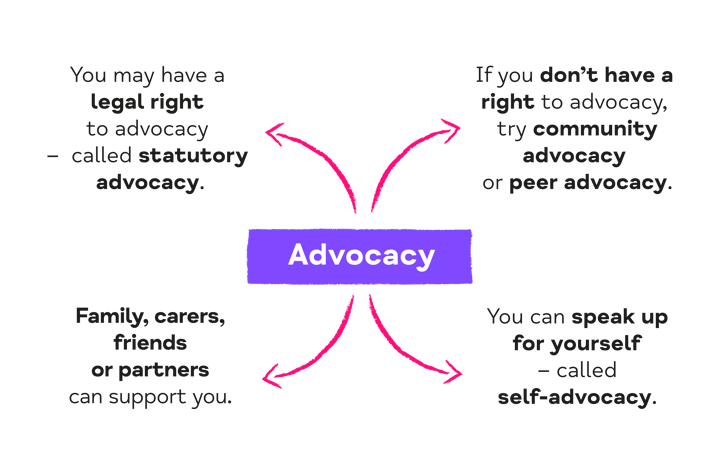
- Have a legal right to an advocate. Like statutory advocates in hospital.
- Don't have a legal right to an advocate. Like community, general or peer advocates.
- Don't want support from a professional advocate. Like if you'd rather get support from family, carers, guardians, friends or partners.
- Want to advocate for yourself. This is called ‘self-advocacy’.
Types of advocacy for mental health
The diagram below explains the main types of advocacy for mental health:

Figuring out what the advocate can do, and how they work, will help you decide whether you want their help. Advocates wouldn't be in that line of work if they didn't want to advocate for people.
When do I have a legal right to advocacy?
In situations where you have a legal right to an advocate, you might hear this called statutory advocacy.
Here are some examples of when you have a legal right to an advocate:
Most advocates in psychiatric hospitals are called Independent Mental Health Advocates (IMHAs). They're not part of the ward staff.
In Wales, you have a right to an IMHA if you are:
- Staying in hospital for mental health treatment and support as an informal patient
- Under certain sections, but not for sections 4, 5, 135 and 136
- Living in the community on a CTO
In England, you have a right to an IMHA if you are:
- Under certain sections, but not for sections 4, 5, 135 and 136
- Living in the community on a CTO
In England, some hospitals might have advocates for informal patients, although it's not a legal right. But there are other ways to get professional support. Find out more in our section on advocacy without a legal right.
How can an IMHA help me?
In any of these situations, an IMHA can help you understand:
- Your rights under the Mental Health Act 1983
- Any medical treatment you're having or might get in the future
They can also help with practical things like:
- Representing you in meetings and ward rounds
- Helping you share your views with ward staff
- Helping you access your medical notes and records
- Making a complaint about your treatment or support
- Making an application to the Mental Health Tribunal
How can I find an IMHA?
If you're in hospital, IMHAs should visit your ward regularly. You can also ask a member of the ward staff to put you in touch with them. Remember that informal patients in England do not have a legal right to an IMHA.
If you're on a CTO, you can ask your care co-ordinator to put you in touch with an IMHA.
The advocate would have a debrief with staff on the ward to talk about things we've raised and what we wanted to happen. I think the ward staff really respected our opinions that we gave to the advocate.
If you want to make a complaint about your NHS treatment and support, you have a legal right to an advocate.
How can an advocate help me?
A statutory advocate can help you complain about the people providing your mental healthcare, like doctors, psychiatrists or therapists. In this situation, you might also hear them called an ‘NHS complaints advocate’.
They can help you:
- Decide if making a complaint is the right thing for you
- Work out what you want to achieve from your complaint
- Write the complaint and send it to the right people
- Understand the response and explain your next steps or options
How can I find an advocate?
In England, contact your local Patient Advice and Liaison Services (PALS).
In Wales, contact your local branch of Llais.
For more information on this topic, see our page on understanding complaints.
I spoke to the advocate regularly and we discussed problems I had with staff and whether to make a formal complaint. We ended up doing that informally.
My care-coordinator was the person who advocated for me the most. She was very good at helping me to advocate for myself as well, because at the time I was very shy and avoided talking to anyone there – Kora, 18
What if I don't have a legal right to advocacy?
If you don't have a legal right to an advocate, you can still get support to make sure your voice is heard. The type of support will depend on your situation and what sort of help you want.
Here are some examples of advocacy support if you don't have a legal right. You won't have to pay for any of these services:
Some services, charities and organisations provide ‘community advocacy’ or ‘general advocacy’. Community or general advocates are professional advocates who support people without a legal right to advocacy.
For example, if you're an informal patient in England and need help sharing your views or problems on the ward. Or if you're experiencing problems with your care at CAMHS.
How can they help?
Community or general advocates can:
- Help you to access mental health services
- Help you find out about different medication or treatment options
- Support you to express your views about your medication or treatment
- Help you write letters or emails to other professionals
- Go with you to meetings and help you prepare for them
- Help you with self-advocacy
Where can I find more information?
Different types of community or general advocacy might be available depending on where you live.
In England, you could contact VoiceAbility, POhWER or Barnardo's. These organisations offer free, professional advocacy services.
In Wales, you could get advocacy support from the National Youth Advocacy Service (NYAS). But another professional, like a social worker, would need to make a referral for you. You could also ask your doctor about local advocacy services.
Peer advocates are people who might:
- Have been through something similar to you in the past
- Have a similar mental health problem as you
How can they help?
Peer advocates can use their knowledge and experience to support you with any problems you're going through. For example, if they've experienced a similar problem to you, they can talk you through how they handled it.
It can feel comforting to speak to people who understand you. You might find it helps to share your experiences with them, too.
Where can I find more information?
You can find about peer advocates for young people on the POhWER website or by contacting your local Mind.
It's good to have someone who has been through the same things as you.
Some charities supporting specific groups also offer advocacy services or legal support. Their support might not always directly relate to mental health.
In England:
- Young people who are experiencing homelessness can get legal advice by contacting Centrepoint
- Young people in care and care leavers can get advocacy from Coram Voice
In Wales:
- Young people who are in care or who have left care can get advocacy from NYAS Cymru
- Young people with additional learning needs can get advocacy from SNAP Cymru
Just because you don't have a legal right to something, that doesn't mean that your needs aren't as great or your experience isn't as bad.

What can I expect from these services?
Depending on where you live, certain types of advocacy services, the way they work and the help they can offer might be different.
When using services that you don't have a legal right to, you might find that some of them:
- Have specific rules about who they can help. If you're unsure, it's worth reaching out to see if they can help you. If they can't, they might be able to tell you who can.
- Need an adult to help with your referral. For example, they might need an adult to fill out or sign a form. This could be someone like a parent, carer, guardian or doctor.
- Have long waiting times for support. While you're waiting, you could get help from family, friends or partners. You could also try advocating for yourself.
I can't find a community, peer or charity advocate
If you're finding it difficult to get support from a professional advocate, there are other ways to get help.
How can I find an advocate?
Advocates usually work for a local or national ‘advocacy agency’. Whether you have a legal right to their support or not, you can find advocates in your area by:
- Asking your council for a list of advocacy agencies where you live
- Searching online for advocacy agencies near you
- Using the keyword ‘advocacy’ on the Barnardo's service search tool
- Contacting your local Mind
- Using the NYAS search tool
- Seeing what's available in different areas of England on the POhWER website
Depending on your situation, you could also ask for help more directly:
- Your school or college might be able to give you information or refer you to an advocate. Speak to your pastoral care team or student wellbeing services for more advice.
- Your doctor might have information on local advocacy services for mental health.
- Your care team should be able to help if you're in hospital for your mental health or getting treatment and support through CAMHS.

My advice for other young people working with an advocate would be to really embrace any activities or tasks that your advocate brings you to do. Even if these activities seem like they won't help.
What if I'm not happy with my advocate?
Whether you have a legal right to their support or not, you might:
- Not feel happy with your advocate
- Feel that you aren't getting the support you need from them
You could first try speaking to them and letting them know how you feel. If that doesn't work, you could:
- Make a complaint to the advocacy service. You can ask the service how to do this. They might ask you to write a letter or email, or to fill in a form. For more information, see our pages on understanding complaints and making complaints.
- Ask the service if you could see a different advocate. They might not be able to find you a new advocate – it depends on how busy they are or how many people work there. But they should listen to how you feel and try to work with you to fix the problem.
Can family, friends or partners advocate for me?
Family members, carers, guardians, friends or partners can help to get your voice heard in some situations. But it's important to remember they aren't the same as professional advocates.
It might help to think about the differences between the support that professional advocates can offer, compared to the people close to you.
With people close to you, you might find that it's easier to:
- Speak to someone you know or who already understands what you're going through.
- Arrange to get support right away from a family member or carer, rather than a professional advocate. For example, if you don't have a legal right to an advocate or can't find support from other types of advocates.
Before asking them to advocate for you
Some things might seem easier with a family member, carer, guardian, friend or partner as your advocate. But other things might feel more difficult.
Before deciding to ask them, try to remember that they:
- Are not independent, unlike professional advocates. They might have their own views about what's best for you – these views might be different to yours.
- Don't need to keep what you tell them confidential, unlike professional advocates. You can still ask them to keep it private, but they don't have to agree to this.
- Might not have experience or feel confident about dealing with the situations or decisions you're facing. Professional advocates will have experience of supporting young people in similar situations. And if they don't have the information you need, they should know how to get it.
- Would need you to share everything about your mental health problem and treatment, which you might not feel comfortable with.
- Might not be able to offer the support you need, or you might not want them to support you in this way.
- Might not feel like they understand enough to help with your situation, even if they have been through something similar.
If you'd like their support as an advocate, ask them how they feel about it. Try to respect whatever answer they give you.

Getting support from another person can be really beneficial, even if it's not a professional advocate.

How can I advocate for myself?
Advocating for yourself means speaking up about the things that are important to you. You might also hear this called ‘self-advocacy’.
Being able to speak up for yourself is really important. But it's not always easy. For example:
- You might feel like you don't know enough about your mental health problem, your rights and how to advocate for yourself.
- You might not feel comfortable or well enough to voice your opinions and ask questions on your own. Especially to professionals like therapists or social workers.
We spoke to young people about what self-advocacy means to them:
It's being able to speak up for yourself rather than relying on others – having the confidence to say when you don't think something is right.
It's about voicing your opinions rather than sitting back and letting professionals make the decisions for you.
It's about being able to explain what you're feeling and what you're thinking yourself. And being able to work through what you're thinking and feeling about certain decisions.
If you want to advocate for yourself, you can still get support from a professional advocate. They can answer any questions you have around self-advocacy and help you with situations you find difficult.
You can also get support from family, friends or partners. Remember: you're not alone.

Now I feel like I can be an advocate for myself as I feel much more confident and independent. However, when you're feeling more vulnerable, it can be difficult to do this.
Finding information
The information you need will depend on your situation and what's going on for you.
You can look for information yourself by:
- Going to our pages on mental health rights and types of mental health problems
- Learning words and phrases you might hear when getting mental health treatment and support in our glossary
- Visiting the medication page on the YoungMinds website
It's about not being afraid to tell whoever I'm talking to that ‘I've read about this and I know what I'm talking about’. It's having confidence in your knowledge.
Preparing for appointments and meetings
It can be easy to forget things we want to say in appointments with healthcare professionals or social workers.
First, try writing a list of the people you need to talk to about what's going on for you.
If you're not sure who they are, you could ask:
- Your care co-ordinator, if you're getting treatment and support through CAMHS
- A nurse, if you're in hospital
To feel more prepared for an appointment or meeting, you could:
- Write down what you want to say in advance
- Practise what you might say in your head, or with a trusted adult or friend
- Bring any information that explains what you want to say
- Write a list of questions to take with you
- Write down how it went and how you felt afterwards
Building up confidence
Advocating for yourself can feel challenging, especially when speaking to professionals who might not agree with you. But building your confidence and self-esteem can help.
If you feel well enough, you can try:
- Looking after your wellbeing and physical health
- Focusing on the positives
- Spending time with people who support you
- Learning to be assertive
For more information, go to our page on confidence and self-esteem.
Here are some self-advocacy tips from young people we spoke to:
Have faith in yourself. You know your mind and body best.
Be persistent and follow up to make sure that progress is being made.
Being interested in my care, I like to get as much information as I can.
Journal or write to keep your thoughts organised.
Stay strong and keep fighting! You may get knocked down along the way, but don't forget what you are fighting for.
Statutory advocate
In some situations, you have a legal right to support from an advocate. This is called statutory advocacy.
For example, if you’re sectioned in hospital, you have the right to an Independent Mental Health Advocate (IMHA).
See our page on advocacy for more information about statutory advocacy.
Visit our full treatment and support glossarySocial worker
A social worker can support you and your family to work through different problems together. Their job is to keep you safe from harm. Some focus on different areas, like mental health or safeguarding.
Visit our full treatment and support glossaryCouncil
Or local council. This is the group of people responsible for certain services in your area, like social care and education.
Visit our full treatment and support glossarySectioned
Being sectioned means that you’re kept in hospital under the Mental Health Act 1983.
There are different types of sections, that have different rules to keep you safe.
The length of time that you can be kept in hospital depends on which section you are on.
See our page on being sectioned for more information.
Visit our full treatment and support glossaryChild and Adolescent Mental Health Services (CAMHS)
These are services that can support you with your mental health.
You might see them called different names sometimes, but they offer the same thing:
- In Wales, they're called Specialist Child and Adolescent Mental Health Services (SCAMHS).
- In England and Wales, you might also hear them called Children and Young People’s Mental Health Services (CYPMHS).
Find out more in our CAMHS information hub.
Voluntary patient
You're a voluntary patient when you, or someone who looks after you, agree for you to stay in hospital to get treatment and support for your mental health. This is sometimes called being an informal patient.
See our page on being an informal patient for more information.
Visit our full treatment and support glossaryReferral
This is a request to a service which asks them to review:
- How you’re feeling
- What support you need
The referral helps explain to the new service why they should see you and what the best way to help you might be.
Sometimes referrals can be made by yourself, a family member or social worker. But they’re often made by your doctor as they understand your medical history.
Psychiatric hospital
This is a hospital where you go to get treatment and support for your mental health.
Visit our full treatment and support glossaryIndependent Mental Health Advocate (IMHA)
An IMHA can help you:
- Understand your rights under the Mental Health Act 1983
- Understand any medical treatment you’re having or might have
- With practical things, like attending meetings or seeing your medical records
See our page on advocacy for more information about IMHAs.
Visit our full treatment and support glossaryWard
This describes the area of the hospital you're staying in. You may also hear it called a unit.
Visit our full treatment and support glossaryMental Health Tribunal (MHT)
This is a special court that you can apply to when you’re sectioned. The tribunal decides whether your section can end. They can also give advice about things like hospital leave, hospital transfers and Community Treatment Order (CTO)s.
In England, the tribunal is called the Mental Health Tribunal. In Wales, the tribunal is called the Mental Health Review Tribunal for Wales.
When you have a tribunal hearing, three people make the decisions. These include:
- A judge
- A doctor
- Someone with experience and expertise in that area of mental health, usually a social worker or nurse
Community Treatment Order (CTO)
This is when you’ve been discharged from hospital but you still need to follow certain rules. For example, taking medication or seeing your doctor. If you become unwell or don’t follow these rules, you could be brought back to hospital.
You can only be put on a CTO if you’ve been on certain sections, like 3 or 37.
See our page on being sectioned for information about the different sections.
Visit our full treatment and support glossaryMental Health Act 1983
This is a law in England and Wales. It means that you can be sectioned if you have a mental health problem and need treatment in hospital to keep you safe.
Visit our full treatment and support glossaryCare co-ordinator
This is your main point of contact if you’re having ongoing treatment and support for your mental health. They should keep in close contact with you and answer any questions you have.
Visit our full treatment and support glossaryCare team
These people look after you when you're getting treatment and support for a mental health problem. Your care team might include nurses, doctors and therapists.
They may look after you in hospital, at home or support you through Child and Adolescent Mental Health Services (CAMHS).
Visit our full treatment and support glossary
Psychiatrist
This is a medical doctor that specialises in mental health. Psychiatrists can:
- Carry out assessments of your mental health
- Decide with you which treatments to try, including medication
- Be your therapist for a treatment, like group therapy
Trusted adult
A trusted adult is someone older than you who:
- Makes you feel safe
- Listens to you
- Treats you with respect, understanding and care
They will have clear boundaries but will support you when they can. They should know when to look for more help if you need it.
You can decide who you feel is a trusted adult to you. You might know them from somewhere like school, your family, places of worship or clubs for young people.
Trusted adults don't have to be the same people as nearest relatives.
Visit our full treatment and support glossaryTherapist
This is a trained professional who runs or supervises your therapy. Therapists help you explore how you’re thinking, feeling and behaving, and what can help you in the future.
You may hear the terms therapist or counsellor used, but they mean the same thing.
Visit our full treatment and support glossaryRights
Rights generally exist to protect and help us. If you have a right or the rights to something in everyday life, it means you're entitled to have it or do it.
Our rights are often set out in laws, like the Equality Act 2010. Sometimes, rights might be set out in other policies and guidelines.
Some rights can never lawfully be taken away from us. However, sometimes another law can interfere with or restrict our rights. For example, if we are arrested or sectioned.
For more information, see our page on your rights.
Visit our full treatment and support glossaryInformal patient
You may also hear this being called voluntary patient. It means that you, or someone who looks after you, agree for you to stay in hospital to get treatment and support for your mental health.
See our page on being an informal patient for more information.
Visit our full treatment and support glossaryConfidentiality
Confidentiality is about keeping your information private.
It means that when you talk to professionals they shouldn’t tell anyone else what you’ve said.
They will only share what you tell them in certain situations. For example, if you ask them to or if they’re worried that you or someone else could be in danger.
See our page on confidentiality for more information.
Visit our full treatment and support glossaryPublished: June 2025
Next review planned: June 2028
We spoke to young people who agreed to give quotes for this page. Their experiences are not related to the people shown in the photos.
References are available on request. If you want to reproduce this content, see our permissions and licensing page.