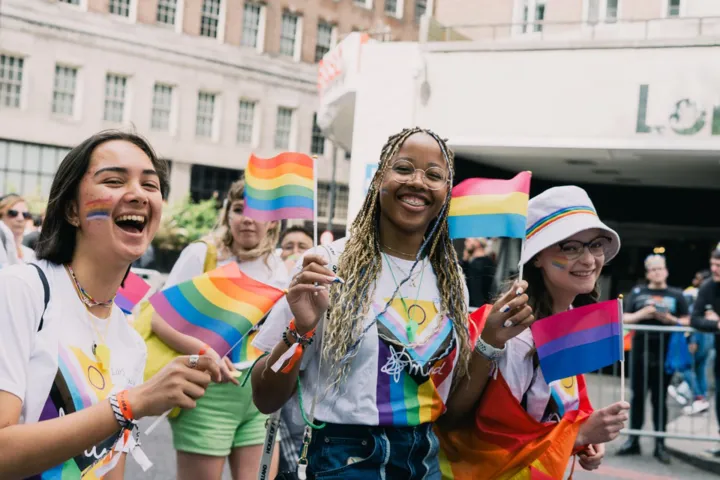
"Being your authentic self"
"Community, acceptance and love"
"A place where you belong"
"Not needing to prove yourself to others"
"Being comfy and confident in who you are"
"Being free to be myself and know I am queer enough"
"It is a cliché, but it is still true: we cannot be what we cannot see. And events like Pride have a role to play in this."

Read more about LGBTQIA+ experiences of mental health
Racism and homophobia damaged my mental health

Julien blogs about the discrimination he has endured while embracing his sexuality.
All we need is acceptance and support

Regan blogs about her experience of transitioning and how she struggled to find the acceptance and support she desperately needed.
Bisexuality and mental health

Jonathan, co-founder and co-chair of the London Bi Network, shares how the stigma surrounding bisexuality has impacted his mental health.
Self care during Pride month
Pride Month is a special time for our community to come together and celebrate LGBTQIA+ identities. But for some, it can be difficult and bring up feelings of shame or stigma, either from ourselves or from others. You might not feel able to come out, or you could face negativity from the people around you.
It can be difficult to feel proud of who you are when you’re facing discrimination, and this can have a huge impact on our mental health. Here's some tips on looking after yourself:
- Tell people what helps. Let people you trust know how they can support you when you’re not feeling great. If you feel comfortable, you might want to tell them what your triggers are so they know how to help you.
- Know your warning signs. Try to be mindful of how you feel over the month. Watch out for signs you might start to feel unwell. They’ll be different for everyone, but knowing them can help you get support faster.
- Keep track of how you feel. Tracking how you feel is helpful to suss out patterns in what’s making you feel good and bad. So you might notice that if you've spent more time on social media this month, it’s made you feel worse. You can keep track with a mood diary, notes on your phone, or with colours. It is not always possible to avoid things that make us feel low, but managing what you can will help.
- Look after yourself. Negative conversations about LGBTQIA+ can be harmful to hear and it might make you feel worse about yourself. Challenge unkind thoughts you might have about yourself – and make sure to do nice things for yourself too. There’s a lot of info about how to do this on our website.
Banning conversion therapy for everyone
Conversion therapy is any attempt to change or 'cure' someone's sexual orientation or gender identity. It's an unethical and harmful practice that must be banned. LGBTQIA+ people don’t need to 'cure' their sexual orientation or gender identity.
Conversion 'therapy' is not therapy. It’s harmful and it’s putting people at risk. We’re calling on the UK government to ban conversion therapy for everyone.
Read about our work to ban conversion therapy
Share your support by asking your MP to lobby the next UK Government for a ban on conversion therapy that includes all LGBTQIA+ people.
LGBTQIA+ mental health
Being LGBTQIA+ does not cause mental health problems. But some things you may go through as an LGBTQIA+ person can make you more likely to experience a mental health problem.
Some things you may go through if you’re LGBTQIA+ include:
- Homophobia, biphobia and transphobia
- Experiences of stigma and discrimination
- Difficult experiences of coming out
- Social isolation, exclusion and rejection
- 'Conversion therapy'
- Difficulties getting the healthcare you need for reasons such as discrimination, or long waiting lists for gender treatment if you’re trans
In fact, because of these issues LGBTQIA+ people are 2 to 3 times more likely to experience a mental health problem.
And many young people experience a lack of inclusive environments – from home to school and beyond. Nearly a quarter of young people who are at risk of homelessness identify as LGBTQIA+.
The impact that discrimination and isolation has on the mental health of LGBTQIA+ people is clear, and avoidable. That’s why we all need to do more to make sure things change – for the better.
Please remember you’re not alone.
How to find mental health support
Mind Infoline
If you need support, feel free to contact our Infoline by phone, email or post. We can give you information on mental health support and signpost you towards help in your area.
Our Infoline is open 9am to 6pm, Monday to Friday, excluding bank holidays.
You can talk to us about things like:
- Mental health problems and wellbeing
- How you can look after your mental health
- Support services available near you
- Treatment options, such as medication and counselling
- Advocacy services
If it is something we can't help with, we can signpost you to services and support that can help.
You can contact our Infoline by:
Phone: 0300 123 3393
Email: [email protected]
Post: Mind Infoline, PO Box 75225, London, E15 9FS
Side by Side
Side by Side is a supportive online community. It's a place we can talk openly about our mental health and connect with others who understand what we're going through.
It’s a safe place to listen, share and be heard. The community is available 24/7, and everyone is welcome.
Local Minds
Our network of local Minds offer mental health information and support to local communities across England and Wales. They’re safe places where we can talk to people who understand mental health problems and the challenges we face every day.
Some of the services your local Mind might offer are:
- Low-cost counselling
- Peer support groups
- Advocacy - that’s where you get support from another person to help you express your views and stand up for your rights
- Other support services, depending on location.
Local Minds with services designed for LGBTQIA+ people
Dorset Mind has a range of support groups for members of LGBTQ+ communities.
The group provides a sanctuary for the LGBTQ+ community, providing a safe space, free from discrimination, where you can share experiences, learn new skills and improve your quality of life.
Outcome is a client-led LGBTQ+ service that has been run by a lesbian, gay, bisexual and trans team for 15 years. They meet every Tuesday between 10:30am and 4:00pm and usually have 35 to 40 clients in each session.
Their main aim is to be a sanctuary for LGBTQ+ people – somewhere safe where they can be themselves, socialise free from discrimination, receive therapies to improve their mental health, learn new skills and acquire knowledge to improve their quality of life.
Rainbow Mind is a service that is specifically for members of the LGBTQ+ community who have mental health problems. The service is staffed and directed by LGBTQ+ people. The service is delivered by Mind in Salford and Mind in City, Hackney and Waltham Forest.