
Got a minute to help? take our quick website survey >
Mental Capacity Act 2005
Explains how the Mental Capacity Act affects you and how you can plan ahead for when you no longer have the mental capacity to make decisions for yourself. Applies to England and Wales.
Deprivation of liberty
- What's a deprivation of liberty?
- When might I be deprived of my liberty?
- What are the deprivation of liberty safeguards (DoLS)?
- What are the conditions for using a deprivation of liberty?
- Is a deprivation of liberty the same as being sectioned?
- How does the authorisation process work?
- Is a deprivation of liberty authorisation always granted?
- Can I challenge the authorisation in court?
- Where can I get support?
- What if I'm in my own home or in supported living?
Deprivation of Liberty Safeguards (DoLS) are due to be replaced by Liberty Protection Safeguards (LPS). They'll work slightly differently to DoLS, but we don’t have all the details yet. We'll update this page once the Government publishes more guidance.
What's deprivation of liberty?
Being deprived of liberty means that you’re not free to go anywhere without permission or close supervision. It means you're supervised all the time.
Your liberty can only be legally taken away from you in very specific situations. It's against the law unless it's done under the rules of the Mental Capacity Act.
A deprivation of liberty should only be used if it’s the least restrictive way of keeping you safe. Or making sure that you have the right medical treatment.
When might I be deprived of my liberty?
Deprivation of liberty can happen if you need to go into a care home or hospital, but you don't have the capacity to make decisions yourself.
How it happens will depend on your circumstances.
- If you’re in a care home or hospital. In this case you can be deprived of your liberty lawfully using procedures called the Deprivation of Liberty Safeguards (DoLS). Or if the Court of Protection has granted permission.
- If you’re living at home, in supported accommodated or in a shared lives placement. In this case you can be deprived of your liberty lawfully if the Court of Protection has granted permission.
- If you need immediate, life-saving treatment in hospital and would die without it, it won't count as deprivation of liberty. So long as the restrictions involved would be the same whether you had capacity or not.
Deprivations of liberty are monitored by:
- The Care Quality Commission (England)
- The Healthcare Inspectorate Wales (Wales)
These bodies write regular reports on the use of deprivations of liberty. But they wouldn't be able to investigate individual cases for you.
What are the deprivation of liberty safeguards (DoLS)?
DoLS include these factors, which healthcare professionals must consider:
- Whether it’s in your best interests to take away your freedom. This means it’s necessary to prevent harm to you. And that the detention is justified, looking at how likely you are to suffer harm. And how serious the harm might be.
- Whether it’s become necessary and unavoidable to take away your freedom. Your healthcare team should make every effort to prevent it from becoming necessary.
- Whether you're at a care home or hospital, or somewhere else. Professionals can't use DoLS to take you from your home to a care home or hospital. This would need an order from the Court of Protection.
Your healthcare team should always treat you in the least restrictive way possible.
They would only need to use DoLS if giving you treatment or care would deprive you of your liberty.
For example, if your healthcare team need to keep you away from places or situations where your safety would be at risk. Like railway lines or busy roads. In this case they could use DoLS to stop you leaving your care home.
But they might not need to use DoLS if you’ll only be in the hospital or care home for a very short time. Like a few hours.
Deprivation of liberty safeguards (DoLS) conditions
DoLS should only be used to lawfully deprive you of your liberty if:
- You’re age 18 or over
- You lack capacity to agree to the restrictions
- You’re staying in a care home or hospital, and they've successfully applied for an authorisation from the local authority
- The deprivation of liberty safeguards have been followed
Court of Protection conditions
The Court of Protection should be used to lawfully deprive you of your liberty if:
- You’re age 16 or over
- You lack capacity to agree to the restrictions
- You live at home, in supported accommodation or in a shared lives placement
- You’re in a care home or hospital but there’s a dispute over your placement there
Example
Jon lives in a care home. He has memory problems that have become worse over time. His condition means that he's less aware of danger than others. He can't cross a busy road on his own. And he doesn’t understand that it’s dangerous to cross a nearby railway line.
Jon needs constant supervision. He has to be stopped from going out on his own. This usually involves keeping him in a locked room and physically stopping him if he tries to go out on his own. To keep him safe, this has to be done on a regular basis.
It would be unlawful for the staff to do this without using the deprivation of liberty safeguards. They should apply to the local authority for permission as soon as they realise it's necessary. This permission is called a standard authorisation.
Is a deprivation of liberty the same as being sectioned?
No. Deprivation of liberty isn’t the same as being sectioned. You don’t need to have treatment for a mental health problem to be deprived of your liberty.
You can be deprived of your liberty to keep you safe. Or it could be to treat other health problems.
If you need to be detained for mental health treatment, this will normally be done under the Mental Health Act 1983.
If you’re already sectioned, health professionals can't use a deprivation of liberty procedure as well.
How does the authorisation process work?
Before you can be lawfully deprived of your liberty, the care home or hospital where you’re staying must apply for authorisation. This means getting permission from the relevant authority. This would usually be from the local authority. If you’re in hospital in Wales, this can also be a local Health Board.
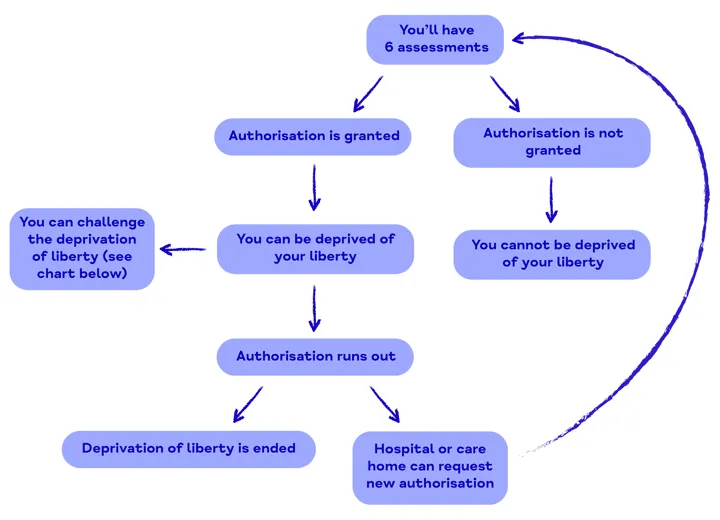
Before the deprivation of liberty is authorised, you’ll have 6 assessments. These may take place at the same time.
The 6 assessments
You can't have your liberty taken away unless all these 6 assessments are met:
- An age assessment, to make sure that you’re aged 18 or over.
- A mental health assessment to confirm that you’ve been diagnosed with a 'mental disorder' within the Mental Health Act.
- A mental capacity assessment to see whether you have capacity to decide where your accommodation should be. If you have capacity, you shouldn’t be deprived of your liberty. The authorisation procedure shouldn’t go ahead.
- A best interests assessment to see whether you’re being, or are going to be, deprived of your liberty. And to assess whether this is in your best interests. This should consider your values and any views you've expressed in the past. It will also consider the views of your friends, family, informal carers and any professionals involved in your care.
- An eligibility assessment to confirm that you’re not detained under the Mental Health Act 1983. And that you're not subject to a requirement that would conflict with the DoLS. This includes being required to live somewhere else under Mental Health Act guardianship.
- A 'no refusals' assessment to make sure that the deprivation of liberty doesn't conflict with any advance decision you've made. Or conflict with the decision of an attorney under a lasting power of attorney. Nor a deputy appointed by the Court of Protection.
Flowchart: How does the authorisation process work?
Is a deprivation of liberty authorisation always granted?
Your deprivation of liberty authorisation won't be granted unless all the conditions in the 6 assessments are met.
The authorisation must also:
- Be in writing
- Include the purpose of depriving you of liberty
- Say why the supervisory body thinks you meet the legal conditions for using a deprivation of liberty
- Contain any conditions attached to the authorisation. Like steps to maintain contact with your family or meet your cultural needs
Your care home or hospital must do what it can to make sure that you and your relevant person’s representative understand:
- The effect of the authorisation
- Your right to request a review
- Your right to apply to the Court of Protection
If your deprivation of liberty authorisation isn't granted, the supervisory body must inform:
- You
- The hospital or care home that made the request
- Any independent mental capacity advocate involved
- Every interested person consulted by the best interests assessor. For example, friends, family and informal carers
Reviewing the authorisation
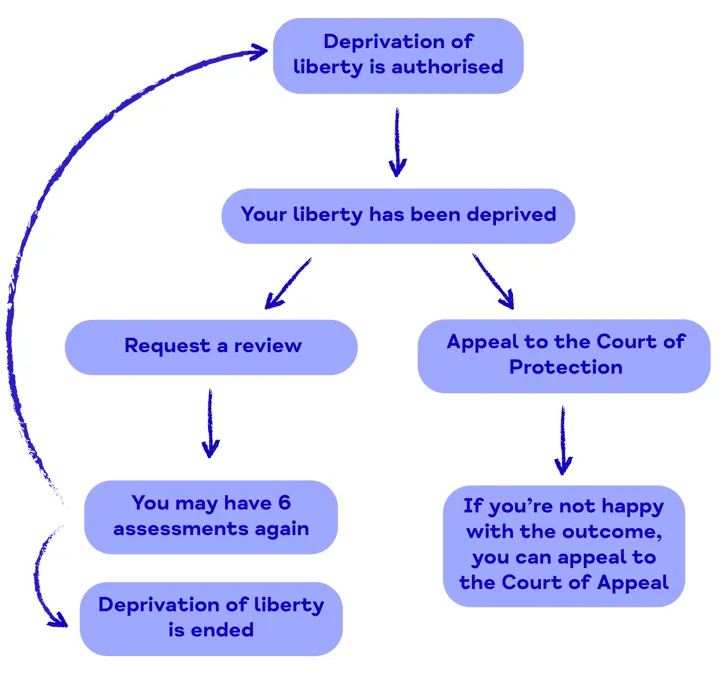
The supervisory body must review the deprivation of liberty authorisation if you ask them to do so. Your hospital, care home or your relevant person’s representative can also ask them to review the authorisation.
You may have to go through the 6 assessments again if your circumstances have changed.
The outcome of the review may be that:
- They end the deprivation of liberty authorisation
- They change the conditions attached to the authorisation
- You still meet the conditions for deprivation of liberty, possibly for a different reason
The supervisory body may also carry out a review at other times. You can ask the local authority to help you with this.
Appealing to the Court of Protection
You have a right to appeal to the Court of Protection against a decision by the supervisory body. Your deputy, attorney or relevant person’s representative also have this right. Any other person can appeal to the court, but they'll need the court’s permission first.
Legal aid is available for you or your relevant person's representative. So you can have legal representation at the appeal.
The Court may tell your hospital or care home that the authorisation has ended. Or they may tell the body that granted the authorisation to change or end it.
See our page on the Court of Protection to find out more.
Flowchart: How can I challenge the authorisation?
What's a relevant person's representative?
This is someone who can:
- Keep in touch with you
- Represent you
- Support you in all matters connected with the deprivation of liberty authorisation
It could be a family member, or someone close to you who you trust.
You can choose who you want this person to be, if you have the capacity. But there may be reasons that somebody isn't eligible to be your relevant person’s representative. For example, if they work for a care home or hospital. Or if they have a financial interest in those places.
If you don’t have capacity to choose your relevant person's representative, other people may choose a suitable person for you. Such as:
- Your attorney acting under an lasting power of attorney
- A deputy appointed by the Court of Protection
- The best interests assessor
The identity of your relevant person's representative will be considered during your best interests assessment. If you’ve nominated someone who's willing to act as your relevant person's representative, the best interests assessor must recommend them.
The supervisory body can stop someone being your relevant person's representative if:
- They think the person might not be in contact with you
- The person isn’t acting in your best interests
- They person is no longer eligible to act as your representative
But they should contact the person to clarify the situation before removing them.
What if I'm in my own home or in supported living?
Health professionals can only use DoLS if you're in a care home or hospital. If you're deprived of your liberty anywhere else, an application must be made to the Court of Protection.
This should be made by:
- In England - the local authority or Integrated Care Board (ICB)
- In Wales - the Local Health Board
How does the application process work?
The body applying for an authorisation must give the court:
- Information about your care arrangements and the reason why any restrictions are necessary
- A capacity assessment showing that you lack capacity to make decisions about your care
- A medical assessment with your diagnosis
- Your wishes and feelings about your care
- The views of anyone interested in your welfare, such as family members
The Court of Protection must consider the best way to involve you in the court case. This might include giving you the opportunity to tell the court what you want. This may involve speaking in the court yourself, or telling someone else what you want the court to know.
It could also include appointing a representative or litigation friend to act for you. They can object to the arrangements for your care if they don’t think they’re in your best interests.
The Court of Protection will authorise the deprivation of liberty if it's satisfied that:
- You lack capacity to make the decision yourself
- The arrangements for your care are in your best interests
The authorisation will last for up to a year and will need to go back to court before it ends. It can be returned to court earlier if:
- The arrangements become more restrictive
- You regain capacity
- Someone believes that the arrangements are no longer in your best interests
Litigation friend
A litigation friend is someone who can take your place in legal proceedings, if you lack capacity to take part yourself. For example, the litigation friend could instruct solicitors on your behalf. Or they could speak to the judge directly on your behalf.
A litigation friend could be a family member, a friend, or the Official Solicitor.
Visit our full listing of Legal TermsClinical commissioning groups (CCGs)
CCGs were replaced by integrated care boards (ICBs) in 2022.
Visit our full listing of Legal TermsDeputy
A deputy is a person the Court of Protection appoints to make decisions for you once you have lost capacity to make them yourself. A deputy usually makes decisions about finances and property.
The court can appoint a deputy to take healthcare and personal care decisions. But this is relatively rare.
Visit our full listing of Legal TermsCourt of Protection
The Court of Protection can make decisions and appoint deputies to act on your behalf. Specifically if you can't make decisions about your personal health, finance or welfare.
See our pages on the Mental Capacity Act for more information.
Visit our full listing of Legal TermsCapacity
'Capacity' means the ability to understand information and make decisions about your life. Sometimes it can also mean the ability to communicate decisions about your life.
See our pages on the Mental Capacity Act for more information.
Visit our full listing of Legal TermsLasting power of attorney
A lasting power of attorney is a legal document that lets you appoint someone to make decisions for you. That person is called an attorney.
See our pages on the Mental Capacity Act for more information.
Visit our full listing of Legal TermsRelevant person's representative (RPR)
This is someone who can support you in all matters connected to a Deprivation of Liberty Safeguards situation. For example requesting a review of the deprivation of liberty and making an application to the Court of Protection. It can be someone like a family member (and often is). You can choose who you want it to be if you have the capacity to do so.
An RPR must be:
- Aged 18 or over
- Willing to be your RPR
- Able to keep in touch with you
- Physically well enough so that they can carry out their role
- An independent person. This means they cannot be your professional or paid carer
Independent mental capacity advocate (IMCA)
An IMCA is a specially trained advocate. They can help you if you don't have the capacity to make particular decisions. NHS bodies or local authorities must take an IMCA's views into account when making decisions that affect you if you've lost capacity. IMCAs are normally appointed by the local authority in England, and by local health boards or other NHS bodies in Wales. They must be independent people of integrity and good character with appropriate experience and training.
See our page on IMCAs for more information.
Visit our full listing of Legal TermsDeprivation of liberty
A deprivation of liberty is where your liberty is taken away from you. This means you're not free to leave and you're under continuous supervision and control. The Mental Capacity Act says that the law allows this only in very specific situations.
This may happen to you if you need to go into a care home or hospital to get care or treatment. But you don't have the capacity to make decisions about this yourself.
Visit our full listing of Legal TermsBest interests
Health professionals must act in your best interests before taking certain steps that affect your care and treatment.
The Mental Capacity Act has a best interests checklist. This outlines what health professionals need to consider before taking an action or decision for you while you lack capacity.
See our pages on the Mental Capacity Act for more information.
Visit our full listing of Legal TermsAdvance decision
An advance decision is an instruction about what medical treatment you want to refuse, if you lose capacity to make decisions in the future. It's legally binding.
See our pages on the Mental Capacity Act for more information.
Visit our full listing of Legal TermsMental disorder
When the Mental Health Act talks about someone with mental health problems, it often uses the term 'mental disorder'. The Act says that this can include "any disorder or disability of mind".
Mental disorder can include:
- Any mental health problem normally diagnosed in psychiatry
- Certain learning disabilities
Deprivation of liberty safeguards (DOLS)
If you're in a hospital or care home, your liberty can normally only be taken away if health professionals use the procedures called the Deprivation of Liberty Safeguards. This protects you from having your liberty taken away without good reason.
See our pages on the Mental Capacity Act for more information.
Visit our full listing of Legal TermsMental Capacity Act 2005 (MCA)
The Mental Capacity Act 2005 is the law that tells you what you can do to plan ahead in case you can't make decisions for yourself. It includes how you can ask someone else to make decisions for you. And who can make decisions for you if you haven't planned ahead.
See our pages on the Mental Capacity Act for more information.
Visit our full listing of Legal TermsMental Health Act 1983 (MHA)
The MHA is a law that applies to England and Wales. It allows people to be detained in hospital (sectioned) if they have a mental health disorder and need treatment. You can only be kept in hospital if certain conditions are met.
See our pages on the Mental Health Act for more information.
Visit our full listing of Legal TermsIntegrated care boards (ICBs)
ICBs are part of the NHS. They:
- Look after the health needs of people in their area
- Plan and deliver services
- Manage the NHS budget
Membership of each board varies but usually includes healthcare professionals and local authority representatives. ICBs were introduced in 2022 to replace clinical commissioning groups (CCGs).
Visit our full listing of Legal TermsLocal authority
This is the local government for where you live. They provide services such as health services, social services, schools, transport and housing.
Each local government decides how services are run. This means that some services in different areas may have different rules.
Visit our full treatment and support glossaryLocal Health Boards (LHBs)
LHBs are a key part of the health service in Wales. They exist to create and deliver services based on the needs of the local community.
Visit our full listing of Legal TermsThis information was published in April 2023. We'll revise it in 2026.
References are available on request. If you would like to reproduce any of this information, see our page on permissions and licensing.


