
Got a minute to help? take our quick website survey >
How to manage feelings of anger
Experiencing anger can be difficult. But there are lots of things we can do to try and manage anger, and improve the way we feel.
You might have to try a few of the tips on this page to see what works best. We're all different, so something that works for you might not work for someone else. You might also find that different tips work at different times.
What's on this page?
Jump to tips and ideas on:
Understanding anger and supporting others
This page has tips and ideas to help you cope with feeling angry.
We have a separate page about how to support another young person when they feel angry.
Before reading our tips, you can also find out what anger means and what it feels like.
I was using anger to suppress other feelings. Managing my anger has helped bring out my better self – Leah, 16

Spot the signs
When we start getting angry, we might feel our:
- Muscles getting tense or tight
- Heart beating faster
- Body becoming shaky or sweaty
We might also experience difficult feelings, like feeling frustrated or unsafe.
Recognising these signs gives us more time to think about how to react. The earlier we notice how we feel, the earlier we can start to manage our anger.
For more signs that you might be feeling angry, see our page on understanding anger.
Take time out
Getting away from the situation, even for a few seconds, can help us work out how we want to react.
When you feel angry, you could try to:
- Go for a walk outside
- Ask if you can take a break and come back to the situation later
We might not always be able to take time out, which can make us feel frustrated. If this isn't possible, try some of our other tips or have a safety plan ready in advance.
If ever I do feel angry, I have safer coping mechanisms to make sure that me and others can stay safe – Leah, 16

Speak to someone
If you can, talk to someone you trust who has nothing to do with why you're feeling angry. This can be someone you know really well, or someone like a teacher or colleague. They might be able to help you understand your feelings and offer support.
For more information, go to our section on talking about anger.
If you'd prefer to speak to someone you don't know, you could:
- Have a confidential chat with a counsellor by contacting Childline or The Mix
- Look for a helpful organisation or service on our useful contacts page
Without speaking to someone, I would still be in such a terrible state.
Try expressing anger in helpful ways
To express anger in helpful ways, try using online resources, like:
- Childline's Toolbox. These resources offer ways to feel better, like creative activities, games, videos and support.
- Kooth's mini-activities. These are tools to help you learn about managing emotions. You'll need to create a free Kooth account to use them.
Or you could try activities like:
- Smashing ice cubes or splashing cold water
- Tensing and relaxing the same types of muscles at the same time, like your fists
- Hitting, squeezing or screaming into a pillow
- Popping bubble wrap
- Scribbling on paper
- Trying some slow breathing, or breathing out for longer than you breathe in
Watch: Breathing exercise
You can watch our video if you'd like to try a breathing exercise.
Breathing exercises might not feel right for everyone, so only try this if you feel comfortable.
We spoke to young people who shared their activities for expressing anger in helpful ways.
Using up energy in your body:
- "Go for a run"
- "Take a walk if you feel safe"
- "Throw a pillow or stuffed object"
- "Do physical exercise"
Creative activities:
- "Write, do doodles or draw"
- "Design a room, clothes or trainers"
- "Write a song to a basic beat"
- "Journal your feelings"
Relaxing activities:
- "Have a shower or bath"
- "Take a nap"
- "Listen to music through headphones"
- "Try mindfulness or meditation"
Sensory activities:
- "Cook or knead dough"
- "Deep, fast breathing"
- "Eat sour sweets"
- "Squeeze or bounce a stress ball"
Social activities:
- "Spend time with pets"
- "Find something to laugh about"
- "Talk about your favourite topic"
- "Take up a class or hobby"
Tips for managing anger at school, college or work
We all have to face difficult feelings and situations at school, college or work. It can feel stressful to spend time with lots of people, follow instructions and manage different activities.
If you're feeling angry at school, college or work, you could try to:
- Explain how you're feeling and what you need. You could use a phrase like ‘I'm feeling angry and need to take a break’. Try to do this in an assertive way.
- Use your break times. If there's a quiet room or safe space where you can go during a break, this might help you cope better with feeling angry. If you're not sure what's available, speak to a teacher or colleague you trust.
- Talk to a teacher, colleague or manager. Let them know how you're feeling as soon as you can. This will help them to support you in the moment. When you're feeling calmer, try to explain how they can help you in the future using a safety plan.
- Separate yourself from people who make you angry. At school or college, you could ask to change seats in the classroom or join a different class, if that's allowed. At work, you could ask to change shifts or work in another role if you feel the need to avoid certain people.


Sometimes if you're angry at school you might not be able to leave and take a breather, like at home.
Reasonable adjustments
If anger is linked to a mental health problem or another condition, your school, college or workplace should make reasonable adjustments for you.
This means if your mental health problem counts as a disability under the Equality Act, you could ask your school, college or employer to:
- Let you take time out when you're feeling angry, without having to ask
- Provide somewhere quiet and calm for you to spend your breaks
- Let you leave earlier so that you can avoid certain situations or people
To find out more about reasonable adjustments, go to our page on understanding your rights.
Tips for coping with arguments
Arguments can be difficult to cope with. But they can be even harder when we feel angry or frustrated, or if the person we're arguing with feels this way.
To better cope during arguments when you feel angry:
- Pause before responding. This might be enough to let your thoughts settle and choose what you want to say. You could also try saying your next sentence in your head before saying it aloud.
- Listen to their point of view. This can help you understand why they feel that way. While listening to what they're saying, try not to think about what you'll say next or talk over them.
It's better to debate rather than aggressively argue – people are more likely to listen to you. As you're both feeling calmer, you're more likely to be listened to and get your point across – Keara, 17

- Think about why you feel angry. Are you angry at the person you're arguing with? Or are you angry about something else and taking it out on them?
- Think about the effects. Will an angry response affect your relationship with them? Will it upset them? Will you get in trouble? Will you feel worse?
- Think about if you'll care about this in 6 months' time. If the answer is ‘no’, it might not be worth continuing to argue about it.
- Leave the situation. If you can't manage your anger, try coming back to things when you feel calmer. This might not be possible, which can make you feel more angry – try asking to pause the conversation instead. This page has lots of ideas to try in case certain tips don't work for your situation.
- Apologise if you've shown anger in a hurtful way. It's okay to feel angry. But if you've acted in hurtful ways while angry, you might need to apologise. You could also explain how you're working on expressing anger in more helpful ways – try telling them about some of the tips you've tried from this page.
Helping another young person with anger
We also have tips on how to support another young person who feels angry.

It's very easy to get frustrated during disagreements and get angry, which won't help to resolve the issue at hand.
Tips for anger online or in messages
If you're finding it hard to deal with a text, social media chat or thread without getting angry, try to:
- Be aware of who you're messaging. Make sure you've thought about who else might see the messages you're planning to send while feeling angry.
- Ask yourself ‘could I regret this later?’ If the answer is ‘yes’, then don't post or message anything.
- Ask yourself ‘could replying make things worse?’ Are you looking for online conflicts on purpose? Is it making you feel worse and taking up a lot of your time? If so, this could be digital self-harm.
- Take a break, go offline and come back to it later. Can it wait for half an hour, or until tomorrow? Take time to think about replying and what to say if so.
Anger sometimes comes without warning, but it's how I act and respond to it that matters most – Emma, 17
Learn your triggers
You could keep a mood diary or journal to make notes about what happens before, during and after you feel angry.
Try to record:
- The day or date and time
- The situation or where you were
- What made you angry?
- How did you feel?
- How did you react?
- How did you feel afterwards?
- How do you think others felt?
- What could you have done differently?
Over a couple of months, you might start to notice a pattern. You can then work out safer and more helpful ways to manage anger in these situations.
Gaining an understanding of my triggers really helped me manage my anger.


Make a safety plan
Having a safety plan means you have a quick way to remember:
- What to do if you need help
- Your warning signs of anger
- Things you can try to help you feel calmer
You can create a plan on your own or with someone else. We also have a version to share with a trusted adult, so they know what to do – or not do – when you feel angry.
Download a safety plan template
Get a safety plan to fill in for yourself or for a trusted adult using the buttons below. Each safety plan will open as a PDF in a new tab.
If you're not sure what a completed safety plan might look like, we have an example. This PDF will open in a new tab.
Try to understand your feelings
It's not always easy to understand how a situation makes us feel. We might feel something we don't understand, or something we've not felt before. Or we might feel a lot of things at once or nothing at all.
Trying to understand our feelings can help us:
- See why we react in a certain way
- Talk to others about how we feel
An emotion wheel can help us talk about feelings that seem hard to work out. We can also learn to spot clues, like changes in our body, thought patterns or how we respond to certain feelings.
How to better understand our feelings
Try using an emotion wheel or get more information on our feelings page.
The emotion wheel will open as a PDF in a new tab.
Let go of anger
Sometimes we can get caught up in anger and hold onto it for a long time. But this can make us feel worse.
To let go of anger, you can try to:
- Use your imagination. Hold your arms out in front of you and imagine you're holding all the anger you feel. When it feels heavy, drop your arms to your side. Imagine the anger going away, dropping to the floor or disappearing into the air.
- Look at the other side of the story. Is there another way to think about what happened? Is it possible that the other person wasn't trying to upset you on purpose? Try to imagine what they think about what happened.
- Think about forgiveness. Forgiveness can help us let go of anger. But it's not easy, and you don't always need to forgive someone if it doesn't feel helpful. You can also try to forgive yourself and treat yourself with compassion.

What you experience is individual, and some things may work and some won't – Leah, 16
Think about the outcomes
If you're thinking about getting angry, it might help to imagine the outcomes by asking yourself:
- Will this help me get what I want?
- Is there another way to reach the same goal?
- How will this affect me and the people around me?
- Is it worth getting angry?
- Will I regret this afterwards?
- Will it affect my relationship with the people involved?
- How might these other people feel in this situation?
Try to do this when you're feeling calm, so you have something to remember in future moments of anger.
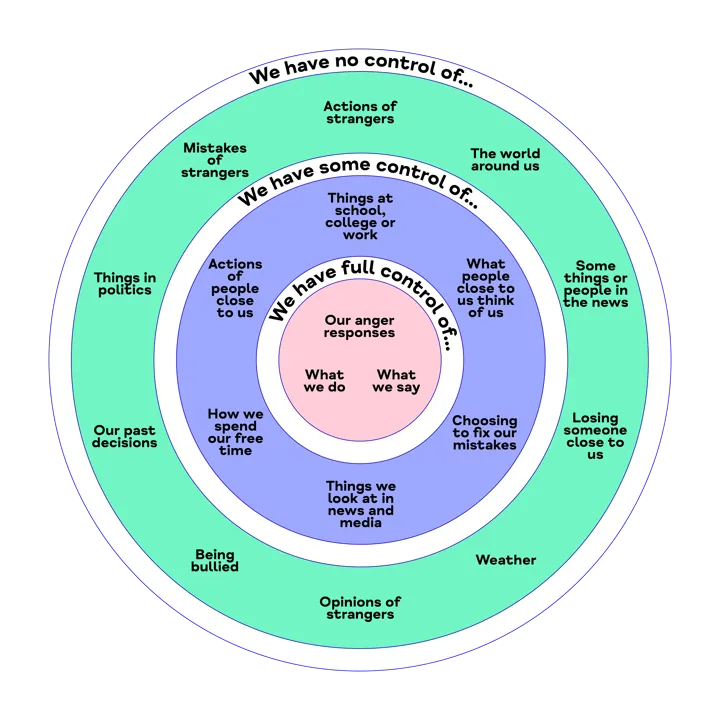
Work out what's in your control
Some things that make us angry might be in our control, like choosing whether to fix a mistake or how to react when someone judges us. But we have less or no control over other things.
We can try responding differently to things we can and can't control. It might help to:
- Make a list of everything that's making you angry
- Highlight or mark which of these are in your control
- Use a different colour or mark for things that are out of your control
For things in our control, we can plan how we're going to handle them.
For things that are out of our control, we can use some of the tips on this page to safely express our anger.
Our circles of control
This diagram explains the idea of circles of control. Circles of control can help us explore and understand things that we have:
- No control over
- Some control over
- Full control of

Look after your wellbeing
Wellbeing is about how we're feeling and how well we can cope with things. Different things can affect our wellbeing, like:
- What we eat and drink
- How often and how well we sleep
- What we do to relax or have fun
Looking after our wellbeing can help us feel calmer and less overwhelmed. This can help us to manage anger. There are so many ways to look after our wellbeing – we're all different and we all need to find what works best for us.
For more information, see our pages on understanding wellbeing and wellbeing tips.


Apps for mental health
Some apps can help us with things like feeling calmer or managing difficult experiences. But with so many apps, it can feel hard to know where to start.
To find safe, trustworthy apps for young people, visit Mind's app library.
Don't bottle it up, or push your anger to the side. Because it will build up and you will eventually explode. Deal with your anger little by little – breathing exercises, writing down how you feel, venting to a friend.

Try some movement
Activity that gets our heart rate up can help us calm down. It does this by using up energy.
Other exercises can also help reduce feelings of anger. Going outside for a walk, especially in nature like a park or woodland, can sometimes help us feel less angry.
For videos, tips and ideas about exercises and activities you could try, visit the NHS website.
Build confidence and self-esteem
We might feel angry from having very little confidence in ourselves or our abilities. This can include the way we see ourselves – like feeling angry because of our body image.
Building confidence and self-esteem could help improve the way we think about ourselves. In turn, this can help us understand and manage anger.
Tips for confidence and self-esteem
Use our tips to help you build up to feeling more confident in yourself.
Learn to be assertive
Being assertive means being able to say what we believe, want, need or how we feel, in a way that's clear, honest and respectful. It's also about standing up for ourselves while respecting other people's views and feelings.
Being assertive can:
- Make communication easier
- Help build healthy relationships
- Support others to understand us
Learning to be assertive might feel hard at first. Don't put pressure on yourself to try everything at once. Whenever you feel ready, have a look at our tips for being assertive.

Be honest and share your thoughts if you feel comfortable.
Turn anger into action
We might feel angry if we experience discrimination or abuse, or see these things happening around us or in the news. Anger is a valid response to these experiences.
When we don't know what to do with the anger we feel, and the reasons seem out of our control, we can sometimes turn anger into action.
You could try these tips and ideas if you're feeling angry about:
Join campaigns through VoiceAbility. Find out more about disability and mental health on the YoungMinds website.
Sign a petition or join a climate strike like the UK Youth Climate Coalition.
Fundraise to support LGBTQIA+ people and support campaigns through organisations like Stonewall Young Futures.
Join campaigns through Action for Race Equality or fundraise for Stand Against Racism & Inequality. For more information about racism and mental health, visit the YoungMinds website.
Look into resources and projects from The Faith and Belief Forum. Report anti-Muslim incidents at Tell MAMA or anti-Semitic incidents at Community Security Trust.
Fundraise or join campaigns to support young women through organisations like the Young Women's Trust.
Although anger and feedback behaviour is a personal responsibility, sometimes it's important to realise how people can provoke you, or be prejudiced or ignorant. This can make you feel like your opinions aren't valid, when they should be shared.

Counsellor
Counsellors listen to you and give you a safe space to explore how you’re thinking, feeling and behaving.
They can help you talk through problems or situations that are affecting you, and help you find ways to cope.
You may hear the terms counsellor or therapist used, but they mean the same thing.
Visit our full treatment and support glossaryDiscrimination
Discrimination is when someone treats you differently or unfairly because of:
- Your age
- Your disability
- Your gender
- Your gender identity
- Your sexuality
- Your relationship status
- Your religion or beliefs
- Your race, skin colour or where you were born
- Being pregnant or having a child
In the UK, a law called the Equality Act protects you from discrimination.
Visit our full treatment and support glossary
Trusted adult
A trusted adult is someone older than you who:
- Makes you feel safe
- Listens to you
- Treats you with respect, understanding and care
They will have clear boundaries but will support you when they can. They should know when to look for more help if you need it.
You can decide who you feel is a trusted adult to you. You might know them from somewhere like school, your family, places of worship or clubs for young people.
Trusted adults don't have to be the same people as nearest relatives.
Visit our full treatment and support glossaryEquality Act 2010
This is the law that protects you from discrimination and gives you the right to challenge it.
The Equality Act says you have a disability if you have a physical or mental health problem that has a substantial, negative and long-term effect on your life.
Visit our full treatment and support glossaryConfidentiality
Confidentiality is about keeping your information private.
It means that when you talk to professionals they shouldn’t tell anyone else what you’ve said.
They will only share what you tell them in certain situations. For example, if you ask them to or if they’re worried that you or someone else could be in danger.
See our page on confidentiality for more information.
Visit our full treatment and support glossaryPublished: June 2025
Next review planned: June 2028
We spoke to young people who agreed to give quotes for this page. Their experiences are not related to the people shown in the photos.
References are available on request. If you want to reproduce this content, see our permissions and licensing page.